Tripura will absorb its entire 2026-27 tariff increase after a smart-meter billing revolt
The smart meter is the sensing layer every argument for edge participation rests on, and Tripura installed it and then declined, by regulation, to send the signal. Rule 8A of the Electricity Rules requires a time-of-day tariff immediately after a smart meter goes in, but TERC's order rules that ToD shall not apply to domestic consumers with connected load up to 10 kW, so an ordinary household with a meter gets prepayment and a higher fixed charge and no price to respond to. Then the state bought out what remained of the price signal, and the regulator, which had already written a two-month non-payment trigger restoring the full tariff into the order, clearly understands that a discretionary subsidy is a price signal held at the pleasure of a treasury. India intends to meter a quarter of a billion connections. This is what the political ceiling looks like when the meter arrives before the legitimacy, and English trade press misses it because it reads as a local subsidy story rather than a grid-edge one.
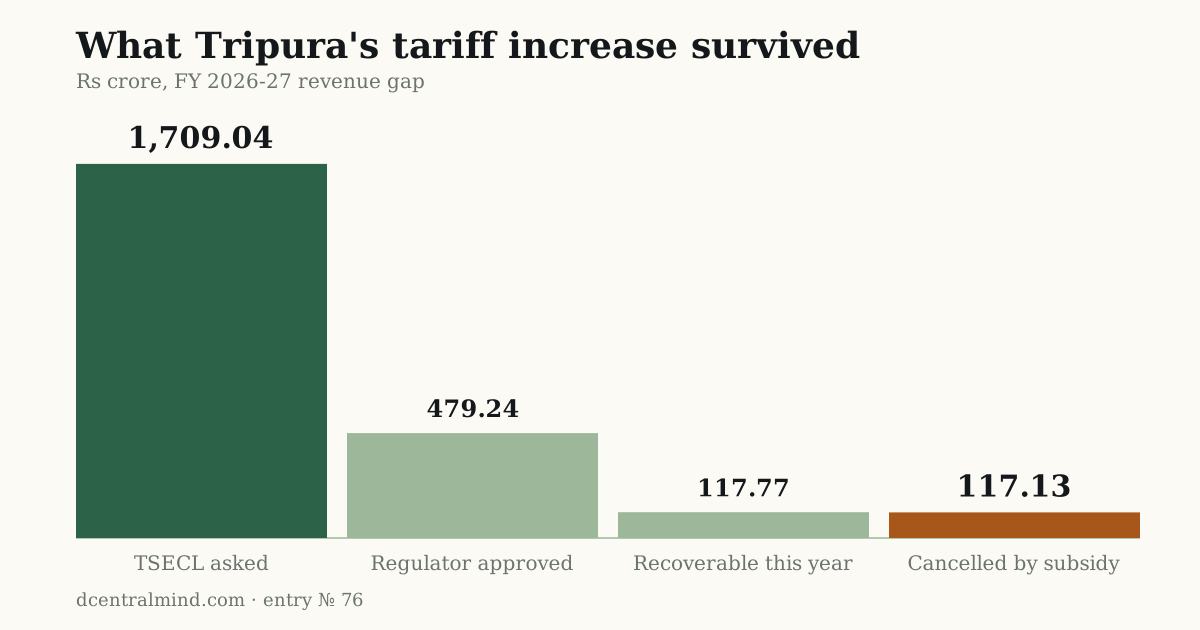
Tripura's state government will absorb the entire additional burden of the electricity tariff set by its own regulator for 2026-27, through a 100 per cent subsidy costing Rs 194.70 crore for the year. Power minister Ratan Lal Nath announced the decision in Agartala on 21 August 2026, a day after a cabinet meeting chaired by Chief Minister Manik Saha. Rs 77.57 crore had already been provided; the new money is Rs 117.13 crore. The relief applies retrospectively from May 2026, and consumers who have already paid at the revised rates will have the excess adjusted across their September, October and November bills. Domestic, small, medium and large commercial and industrial consumers get the full 100 per cent. Railway traction, defence installations, All India Radio and Doordarshan get 15 per cent. Nath called the decision unprecedented in the history of Tripura.
The announcement came eleven days after consumers protested outside the Jirania electricity office over smart-meter billing, and in the middle of a sustained agitation over what prepaid recharges were actually buying.
What the tariff order actually did
The order being subsidised is the Tripura Electricity Regulatory Commission's Tariff Order for FY 2026-27, disposing of Petition No. 02 (Truing-up) of 2026 and Petition No. 03 (MYT) of 2026, signed by chairman Hemant Verma and member Puspita Chakraborty at Agartala on 4 May 2026 and in force from 1 May 2026.
TSECL asked to recover a revenue gap of Rs 1,709.04 crore. The Commission approved a gap of Rs 479.24 crore and allowed only Rs 117.77 crore of it to be recovered in 2026-27, citing the Supreme Court's regulatory-asset directions in the BSES Rajdhani litigation and taking one-fifth of the 2023-24 true-up gap, one-third of the 2024-25 gap and the full carrying cost of Rs 149.59 crore. Recovering the whole approved gap in one year, the Commission wrote, would have required a tariff increase of around 43 per cent, which it described as a tariff shock.
How it recovered the smaller amount is the part that matters. The Commission observed that fixed charges contributed only about 5 per cent of TSECL's revenue, decided to rationalise them to north-eastern and pan-India levels, and allowed only marginal increases in energy charges: 15 to 20 paise per unit for domestic consumers, 20 paise for irrigation, public water works, public lighting and special utility, and 35 paise for everyone else. The approved schedule sets a domestic fixed charge of Rs 70 per kW per month, rising to Rs 125 per kW per month on three-phase connections, which are compulsory above 4 kW. Small commercial is Rs 150, semi-commercial Rs 195, mobile towers Rs 320.
So the increase Tripura consumers met in May was mostly a shift from what you use to what you are connected to.
The arithmetic behind the complaint
At the Jirania protest on 10 August, one consumer said she recharged Rs 1,000 and received only around 160 units. That number is worth checking against the order rather than against a meter.
The subsidised domestic schedule in Annexure 2 of the tariff order prices the first 50 units at Rs 4.86, units 51 to 150 at Rs 6.41 and units 151 to 300 at Rs 7.32. On those rates, 160 units costs about Rs 957 in energy charges. Add the Rs 70 per kW monthly fixed charge for a 1 kW sanctioned load and the total is about Rs 1,027. Roughly Rs 1,000 for roughly 160 units is what the approved schedule produces. [This is dcentralmind's arithmetic on the published schedule, not a figure from the order. It excludes electricity duty and any meter rent, which were not checked, and it assumes the household is billed at the subsidised rates and at a 1 kW sanctioned load.]
That calculation does not prove the meters are accurate. It does show that the single most-quoted grievance in the agitation is consistent with the tariff the regulator approved, and that an argument being conducted about hardware may be an argument about a tariff structure. [UNVERIFIED: no source read establishes whether the disputed bills reflect meter error, the fixed-charge rationalisation, prepaid recharge accounting or something else. Every source is silent on cause, including the minister's own.]
The political response
At a press conference on 11 August, Nath said the state government could not remain a silent spectator, distinguished smart meters from prepaid meters, and attributed the smart-metering programme to the previous Left Front administration: a Rs 80.07 crore smart-grid work order issued on 22 September 2015 to a Wipro-led consortium for Electrical Division-I in Agartala. He cited an audit dated 23 October 2024 flagging Rs 42.76 crore as unfruitful expenditure, and said that of 45,290 planned meters, 43,081 were installed by July 2019 after a 27-month delay, with only 34,300 initially communicating with the control centre. TSECL has roughly 10.68 lakh consumers and 1.64 lakh standalone prepaid meters. Officials were instructed to withhold collection of abnormal bills pending examination. [UNVERIFIED: these are a serving minister's characterisations of his political predecessors, reported by a single outlet. The audit report was not obtained, and no written order freezing collection was located.]
Why it matters
The smart meter is supposed to be the device that makes a household's consumption legible, priced and disputable in close to real time. It is the sensing layer that every argument for edge participation rests on: without it there is no time-of-day signal, no demand response, no settlement of anything a household exports.
Tripura installed the sensing layer and then decided, by regulation, not to send the signal. Rule 8A of the Electricity Rules requires a time-of-day tariff to take effect immediately after a smart meter is installed. TERC's order, at paragraph 7.5.23, makes time-of-day tariffs mandatory for commercial, industrial, non-domestic, mobile tower, water works and bulk categories, and then rules that they shall not apply to domestic consumers with connected load up to 10 kW. Tripura's solar hours run 09:00 to 17:00 at 80 per cent of the normal energy charge and its peak runs 17:00 to 22:00 at 110 per cent for non-industrial consumers, and an ordinary household with a smart meter sees none of it.
What a Tripura household got from the meter, then, was prepayment and a fixed charge, with no price to respond to. That is the sensing layer delivered without the participation it was supposed to enable, and the predictable result is not a flexible consumer but an angry one.
Then the state removed the price signal that was left. Note that the Commission had already anticipated this: the order carries an existing Rs 77 crore government subsidy, structured in Annexure 2 as a per-unit energy rebate, and it directs TSECL to revert to the full unsubsidised tariff if the Government of Tripura fails to pay the subsidy in advance for two consecutive months. The regulator wrote the restoration trigger into the order because it knows what a discretionary subsidy is: a price signal held at the pleasure of a state treasury, and removable by it.
India intends to place smart meters on a quarter of a billion connections. Tripura is a small demonstration of what the ceiling looks like when the meter arrives before the legitimacy does, and it is under-covered in English trade press precisely because it reads as a local subsidy story rather than a grid-edge one.
India context
Tripura's metering rollout runs under RDSS. In objections filed in this proceeding, Prayas (Energy Group) told the Commission that TSECL has spent Rs 589 crore on loss reduction works with 55 per cent complete and Rs 316 crore on smart metering with 50 per cent complete, and asked the Commission to hold distribution loss to 17 per cent for 2026-27 with a roadmap to 12 per cent by April 2028, the RDSS sunset. The Commission approved 16.20 per cent distribution loss and 18.30 per cent T&D loss for 2026-27 against trued-up actuals of 25.70 per cent and 27.56 per cent. The gap between those two pairs of numbers is the real reason the tariff moved, and the subsidy does not close it.
What is still unknown
Whether the disputed bills are a meter defect, an effect of the fixed-charge rationalisation, a prepaid accounting problem, or a mix. No source establishes the cause, and no independent meter testing was reported.
Whether the fixed charge is deducted from a prepaid balance in Tripura, and on what cycle. The order sets the charge; the deduction mechanics were not located. [NEEDS DATA: how TSECL's prepaid vending applies the monthly fixed charge.]
How many of TSECL's 10.68 lakh consumers hold smart or prepaid meters today, as against the 1.64 lakh standalone prepaid meters and the 43,081 smart meters from the 2015 programme.
Whether the collection freeze on disputed bills rests on a written government or TSECL order, and what its scope is.
Whether the 100 per cent subsidy continues past 2026-27, and what happens to the tariff in 2027-28 if it does not. A subsidy structured as a per-kWh energy rebate also does not obviously neutralise a fixed-charge increase for a low-consumption household, and no source explains how the August decision is being applied to the fixed charge.
The claim by Samyukt Kisan Morcha that around 6,000 people were arrested in Agartala on 10 August 2026 during a CPI(M)-led protest. This is the organisers' figure, reported in press, and is not confirmed by police or state figures.
Sources
Tripura Electricity Regulatory Commission, Tariff Order for TSECL for FY 2026-27, dated 4 May 2026, 215 pages: https://terc.tripura.gov.in/sites/default/files/documents/TERC%20Tariff%20Order%20for%20FY%202026-27.pdf
ENewsTime, 21 August 2026, on the cabinet decision and the subsidy figures: https://enewstime.in/tripura-news/tripura-electricity-tariff-100-pc-subsidy-2026-107927.html
ENewsTime, on Nath's press conference of 11 August 2026: https://enewstime.in/tripura-news/tripura-power-bill-smart-meter-resentment-ratan-lal-nath-left-front-107601.html
Tripura Chronicle, on the Jirania protest of 10 August 2026: https://tripurachronicle.in/local-news/consumers-protest-at-jirania-power-office-over-smart-meter-billing/
The Shillong Times, 21 August 2026: https://theshillongtimes.com/2026/08/21/tripura-govt-to-bear-100-pc-of-enhanced-power-tariff-through-subsidy/
Northeast Today: https://northeasttoday.in/northeast/tripura-govt-will-bear-100-burden-of-tariff-hike-minister-ratan-lal-nath-announces-full-relief-for-power-consumers/
SolarQuarter, 21 August 2026, on the recovery cap: https://solarquarter.com/2026/08/21/terc-rejects-arbitrary-tariff-hike-claims-caps-fy27-recovery-at-inr-117-77-crore-in-tripura/
Public comments
Loading…