Uttar Pradesh's peer-to-peer trading pilot has published its first numbers: 1,164 trades in six months, and a collapse from 567 in May to 37 in July
Peer-to-peer trading is the strongest available test of whether a distribution utility will let two of its own customers transact with each other rather than through it, and India now has the first published monthly series from a live inter-state pilot. The series is the argument: the pilot's own numbers show activity falling by more than nine in ten between May and July, which makes 'extended after initial success' a claim the data does not carry, and makes the seven-month extension a second chance rather than a scale-up.
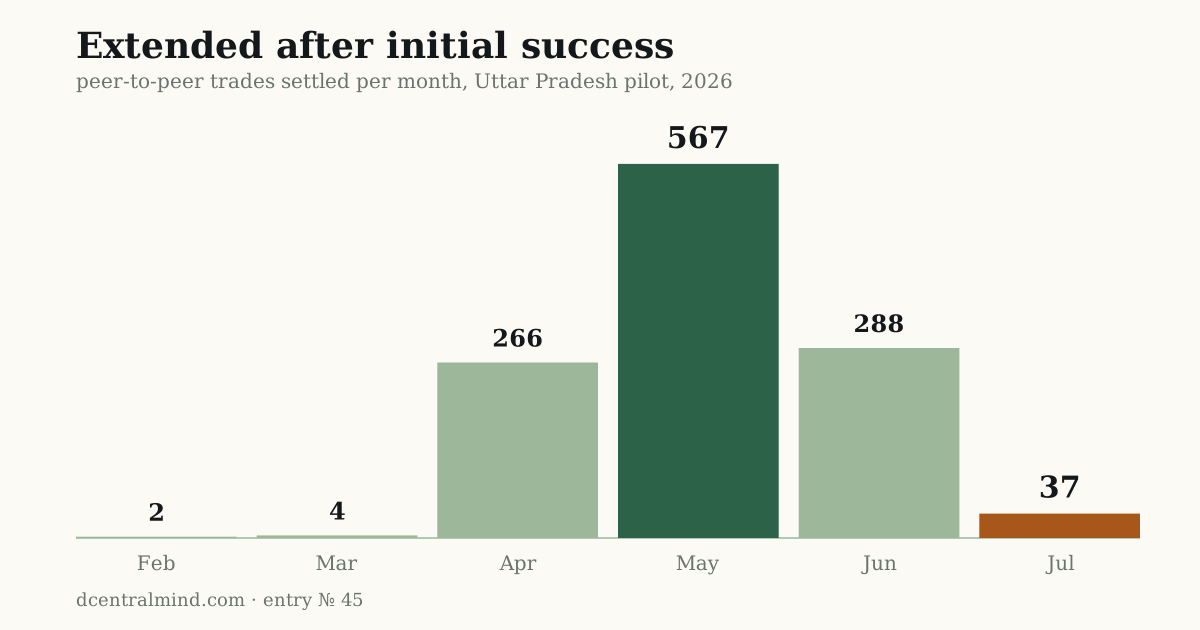
Uttar Pradesh's electricity regulator has extended the state's peer-to-peer renewable energy trading pilot to 31 March 2027, and the extension petition carries the first public numbers the pilot has produced. Pashchimanchal Vidyut Vitran Nigam (PVVNL), the distribution company running Uttar Pradesh's side of the scheme, told the Uttar Pradesh Electricity Regulatory Commission that 1,164 trades were executed and settled between February and July 2026. The monthly series, as reported by Energetica India and Mercom India, runs: two in February, four in March, 266 in April, 567 in May, 288 in June, and 37 in July. Regular trading began in March, and the traded energy was adjusted in participating consumers' electricity bills. The Commission continued the approvals and relaxations it had granted in its order of 16 February 2026, with the extension taking retrospective effect from 16 August 2026. Phase I of the pilot links PVVNL in Uttar Pradesh with Tata Power Delhi Distribution and BSES Rajdhani Power in Delhi, which is what makes it more than a single-DISCOM experiment. The shape of that series is the story. A pilot that reached 567 settled trades in May recorded 37 in July, a fall of more than nine in ten over two months. Neither the coverage nor any retrieved order explains the decline. Seasonal suppression of rooftop output during the northern Indian monsoon is the obvious hypothesis, and it is only a hypothesis; nobody has published one. [NEEDS DATA: traded energy volume in kWh, participant counts, clearing prices]
Two things follow. First, "extended after initial success", the framing carried in some coverage, is doing work that 1,164 trades over six months across three distribution utilities cannot support. Second, the pilot now has a further seven months to produce a result, and this sweep could find no published reporting requirement attached to the extension. The reason the first six months' figures are public at all is that PVVNL needed an extension and had to file for one. The wider point is why peer-to-peer matters as a test rather than as a product. A distribution utility's core function is to stand between the person who generates and the person who consumes. A P2P pilot asks that utility to let two of its own customers transact around it, on its wires, and then to settle the result in their bills. That is a genuine transfer of a function to the edge, which is exactly why it tends to be granted in pilot form, on relaxations, with an expiry date. The numbers now on the record are the first evidence anyone has about what happens when it is.
Public comments
Loading…